

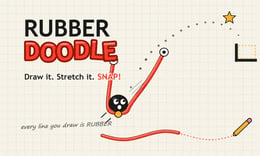


🎮 Rubber Doodle
⭐ Crazy3D Editor's Pick: A line is not just a bridge here: it bends, catches a falling ball, and can send it moving in a new direction. Rubber Doodle makes a small drawing decision visible through the motion that follows.
🔎 What is Rubber Doodle?
Rubber Doodle is a single-player drawing and physics puzzle. Your goal is to get a small dark ball into the marked cup, using elastic lines rather than moving the ball directly. The notebook-like stage gives you fixed points, obstacles, and empty space to turn into a useful route.
The opening “Pin to Pin” tutorial shows the idea clearly: connect two anchors, then cut the short band suspending the ball. It drops onto your new band and rolls toward the cup. Drawing the line is only the preparation; gravity and the line’s shape determine what happens next.
🕹️ How a puzzle works
- Start with Play. The hosted player may show an advertisement first; use its normal skip control when available, then return to the game.
- Find the ball, the cup, and the anchor points. Look for a route that leads all the way to the target rather than simply catching the initial fall.
- Drag between suitable pins or black ink to draw an elastic band. Check where its slope will send the ball.
- Tap the band holding the ball to release it. Watch the complete movement before changing your design.
- Rework an unsuccessful route or continue after success. The first tutorial’s result offers Next, Try another way, and Replay, so you can compare solutions instead of only moving on.
🎯 Controls
| Action | Input |
|---|---|
| Draw a band | Mouse drag or Touch drag between valid anchors |
| Release the suspended ball | Click or Tap its holding band |
| Stretch and launch | Drag a band, then release |
| Undo the last band | Z or the undo button |
| Restart the stage | R or the restart button |
| Show a hint | The Light bulb control when available |
The tested restart tooltip says one restart keeps your bands and a second clears them. Follow the current stage’s prompts: a useful action may depend on what the tutorial has introduced.
🏆 Tutorials and progression
The supplier describes three tutorials and 75 stages, with stars and additional worlds to unlock. It also lists later obstacles such as saws, lasers, portals, keys, boost arrows, and reversed gravity. These are supplier descriptions of the wider game, not a claim that every stage was tested.
Our desktop iframe check completed the first tutorial: the band count changed from zero to one, the released ball rolled into the cup, and a Nice! result appeared. Later worlds and their completion requirements remain outside that small test.
✨ What makes the puzzles different
Elastic routes
A band can catch the ball without behaving like a rigid floor. Think about how the landing changes its shape and therefore the next part of the route.
Deliberate release
The hanging ball waits while you prepare. Separating construction from release lets you inspect a design before committing it to physics.
Anchors give drawings a purpose
Pins are not decoration: they define useful endpoints. A well-chosen pair can create a reliable slope with less clutter than several overlapping bands.
More than one solution
The option to try another way encourages experimentation. A successful route can be a starting point for understanding the mechanics rather than the only answer worth keeping.
🧠 Practical tips
- Trace the ball’s entire journey mentally, including how it will leave the final band and enter the cup.
- Start with one useful band. Extra lines can intercept the ball in places you did not intend.
- Let a released ball finish moving before restarting; an apparent miss may still become a successful bounce.
- Change one endpoint or one band at a time, so you can understand why the next attempt behaves differently.
- Remember that overstretching can snap a band. Try a modest change before assuming more tension is always better.
📱 Desktop and touch play
A mouse makes it easier to place endpoints precisely and observe the result without covering the playfield. The supplier also lists touch controls, but the recorded check used desktop input, not a phone or tablet. Mobile comfort therefore remains unverified.
Keep the whole stage visible, particularly the cup and outer anchor points. If scrolling moves the surrounding webpage instead of the game, click inside the player before using keyboard shortcuts. Advertising and loading belong to the hosted player and should not be mistaken for the puzzle itself.
❓ Frequently asked questions
Is it free to play?
The supplied browser version is free to start and may display advertising. You do not need to install a separate game application for this version.
Do I draw the ball’s exact path?
No. You draw elastic supports and then let the ball interact with them. Shape, release, and gravity matter more than tracing a perfect line from start to finish.
Was the entire game verified?
No. The first tutorial was completed in a third-party HTTPS test page using the site’s iframe attributes. That proves this observed desktop interaction, not production deployment or completion of every level.
🔗 More games on Crazy3D
Try Rope Chef for another object-routing challenge, Try Again for careful ball movement, or Wake Up the Box for more physics puzzles. Browse New Games and the Crazy3D collection when you want a different kind of short session.
▶️ Play Rubber Doodle
Build a simple route, release the ball, and watch what your drawing actually does. Play Rubber Doodle on Crazy3D.


